
Mapping Import and Export Process Inefficiencies Across the Supply Chain
Identify import and export process inefficiencies, avoid costly delays, and improve global trade workflows with better operational processes.

Discover how NEX significantly enhanced First Atlantic Commerce's
operations, billing processes, and overall data management efficiency.
11 min read

Multi-currency accounting helps importers and exporters record, manage, and report transactions in different currencies while maintaining accurate financial records. As international operations grow, however, managing exchange rates, landed costs, supplier payments, and inventory across multiple currencies becomes increasingly difficult, especially when operational data lives outside the accounting system.
According to PwC’s 2025 Global Treasury Survey, 36% of treasury teams still manage foreign-exchange exposure through manual processes. The finding illustrates how currency management can remain fragmented and labor-intensive even as businesses expand their international operations.
These challenges often result in manual currency conversions, lengthy reconciliations, inaccurate inventory costs, and limited visibility into profit margins. QuickBooks remains a strong accounting platform, but many growing businesses need connected operational workflows that keep finance, purchasing, inventory, and logistics aligned.
NEX's Import & Export Software extends QuickBooks by connecting these workflows, helping businesses simplify multi-currency operations without replacing their accounting system.
Multi-currency accounting is the process of recording, managing, and reporting financial transactions in more than one currency. It allows businesses to buy from international suppliers, sell to customers in foreign markets, and maintain accurate financial records even when transactions occur in different currencies.
For importers and exporters, this goes beyond simply converting one currency into another. Every purchase order, supplier invoice, customer payment, freight charge, and customs-related expense can involve a different exchange rate. Without a consistent process for managing these transactions, finance teams spend more time reconciling records than analyzing business performance.
As international operations expand, multi-currency accounting becomes an operational challenge as much as a financial one. Purchasing, inventory, logistics, and accounting must all work from the same financial data to ensure costs, revenues, and profit margins remain accurate.
International trade naturally exposes businesses to multiple currencies. A Canadian importer may purchase inventory in U.S. dollars, pay ocean freight in euros, receive invoices from Asian suppliers in local currencies, and sell products domestically in Canadian dollars. Each transaction affects the company's financial records differently.
Managing these activities manually often creates unnecessary complexity. Exchange rate fluctuations can change product costs between the time an order is placed and when payment is made. Without proper currency management, finance teams may struggle to determine the true cost of inventory, calculate landed costs accurately, or explain unexpected gains and losses.
As transaction volumes grow, businesses also need greater visibility into how currency movements affect purchasing decisions, profitability, and cash flow across the entire supply chain.
Read Next: The Hidden Landed Cost Mistakes Quietly Draining Your Import Export Margins
Most import and export businesses manage dozens, if not hundreds, of multi-currency transactions every month. While each transaction may appear straightforward on its own, together they create significant accounting complexity. Common examples include:
The challenge is rarely QuickBooks itself. Rather, the complexity comes from managing operational data across purchasing, inventory, logistics, and finance using disconnected spreadsheets and manual processes. Every manual currency conversion increases the likelihood of reporting errors, reconciliation delays, and inaccurate inventory costs.
Businesses that centralize these workflows around a single source of operational data are better positioned to maintain accurate financial records while reducing the manual effort required to support international growth.
Read More: 9 Signs When To Move Beyond QuickBooks for Global Trade
Managing a handful of foreign currency transactions is relatively straightforward. The complexity begins when import and export businesses handle multiple suppliers, countries, warehouses, and shipping partners simultaneously. At that point, multi-currency accounting becomes less about individual transactions and more about keeping every department working from the same financial reality.
Finance teams must account for changing exchange rates, inventory purchased in different currencies, freight costs, duties, and customer payments while ensuring financial reports accurately reflect the company's reporting currency. When these processes rely on spreadsheets or disconnected systems, errors become increasingly difficult to prevent and even harder to trace.
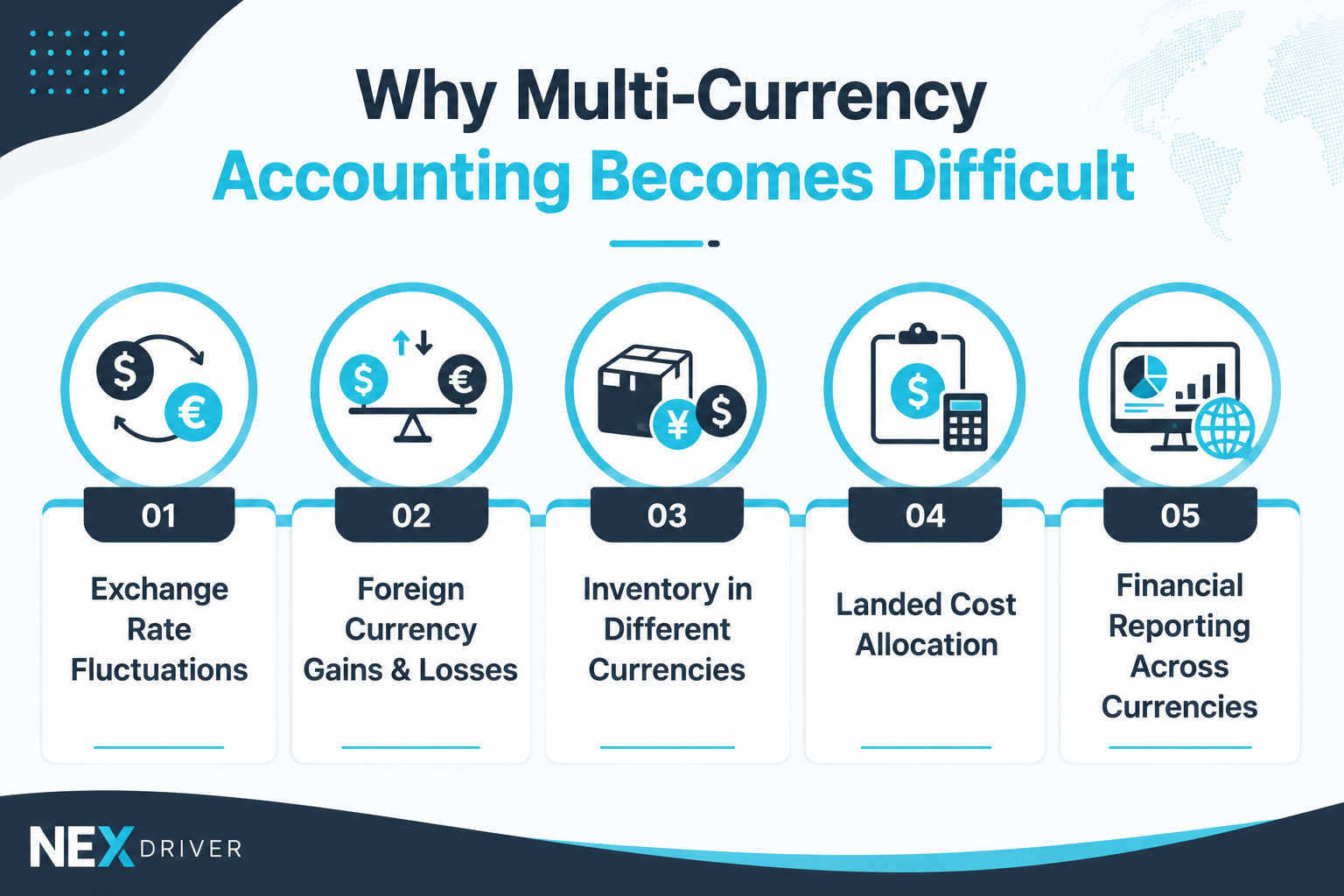
Exchange rates rarely remain static between the time an order is placed and when payment is received. An importer may negotiate pricing with a supplier today but settle the invoice weeks later under a different exchange rate. These fluctuations can affect:
Purchase costs
Inventory valuation
Accounts payable and receivable
Cash flow forecasts
Overall profit margins
Without a standardized process for updating exchange rates and recording currency movements, finance teams often spend significant time adjusting transactions manually. The larger the transaction volume, the greater the administrative burden and financial uncertainty.
Whenever exchange rates change between the original transaction and final settlement, businesses may recognize foreign exchange gains or losses.
For example, a purchase order may be created when one U.S. dollar equals 1.35 Canadian dollars. If payment is made after the exchange rate moves to 1.39, the business pays more in its functional currency than originally expected.
While these gains and losses are a normal part of international business, manually tracking them across hundreds of invoices, supplier payments, and customer receipts increases the likelihood of reporting inconsistencies and lengthy month-end reconciliations.
Inventory purchased from international suppliers often arrives with costs incurred in several currencies. The product itself may be invoiced in one currency, freight in another, and insurance or customs-related charges in a third.
Without a centralized workflow, finance teams must manually determine which exchange rates apply to each transaction before inventory can be valued correctly. This creates several operational risks:
For many importers, the purchase price represents only a portion of the total cost of bringing inventory into the warehouse. Freight charges, insurance, customs duties, brokerage fees, and handling costs all contribute to landed cost, and each may be billed in a different currency.
If these costs are converted manually or tracked outside the accounting system, businesses may underestimate the true cost of inventory and make pricing decisions based on incomplete financial information.
Accurate landed cost allocation helps finance and operations teams understand product profitability, negotiate better supplier agreements, and improve purchasing decisions.
As businesses expand internationally, producing accurate financial statements becomes more challenging. Transactions originating in multiple currencies must ultimately be consolidated into the company's reporting currency while remaining compliant with accounting standards.
This requires more than simple currency conversion. Finance teams must ensure exchange rates are applied consistently, foreign currency balances are properly revalued, and reports accurately reflect the financial impact of currency movements.
When accounting data, purchasing records, inventory, and logistics operate independently, preparing month-end reports often becomes a manual reconciliation exercise rather than an efficient financial review.
Businesses that connect operational workflows with their accounting system gain more reliable financial reporting, better visibility into currency exposure, and faster access to the information needed for strategic decision-making.
Read Next: Still Using Spreadsheets For Import Export? The Hidden Cost Is Higher Than You Think
QuickBooks is an excellent accounting platform, but international trade introduces operational complexity that extends well beyond accounting. As businesses add overseas suppliers, multiple warehouses, freight providers, and foreign currency transactions, finance becomes increasingly dependent on information generated elsewhere in the business.
Managing multi-currency accounting involves far more than recording transactions in different currencies. Supplier purchasing, freight, landed costs, inventory, and customer orders all influence the final financial picture. As these workflows become more complex, keeping operational data synchronized with accounting requires considerably more coordination.
Accounting records what happened. Operations determine what is happening.
An overseas purchase, for example, begins long before an invoice reaches QuickBooks. Purchasing negotiates with suppliers, logistics arranges freight, warehouse teams receive inventory, and finance reconciles costs after the shipment arrives. Each department contributes information that ultimately affects inventory valuation, landed costs, and financial reporting.
When these activities are managed in disconnected systems, finance teams spend less time analyzing performance and more time verifying whether every department is working from the same numbers.
Read More: QuickBooks ERP Integration: Methods, Tools & Business Solutions
International trade changes constantly. Freight costs increase, shipment dates move, inventory arrives in stages, and supplier invoices are revised after purchase orders are created. If logistics sees these changes before finance does, accounting records quickly fall behind operational reality.
That disconnect creates a familiar cycle. Finance updates inventory costs after receiving revised freight invoices. Purchasing works from one landed cost estimate, while accounting reports another. By month-end, teams spend days reconciling information that should have remained synchronized from the beginning.
Many businesses still rely on spreadsheets to calculate exchange rates outside their accounting system. While that approach may work with a small number of international transactions, it becomes increasingly difficult as suppliers, customers, and currencies multiply.
Each manual conversion introduces another opportunity for inconsistent exchange rates, duplicate calculations, or reporting differences. Instead of reviewing financial performance, finance teams often find themselves validating formulas, updating spreadsheets, and investigating why balances no longer reconcile.
Read Next: Still Using Spreadsheets For Import Export? The Hidden Cost Is Higher Than You Think
Inventory rarely arrives with a single cost attached to it. Product prices, freight, duties, insurance, brokerage fees, and currency fluctuations all contribute to the final landed cost.
When purchasing records, inventory data, and accounting are maintained separately, it becomes difficult to determine what inventory actually costs. Pricing decisions become less reliable, profitability reports lose accuracy, and finance teams spend more time adjusting historical transactions than planning future purchases.
Financial reporting should help leaders understand how the business is performing, not become a monthly reconciliation project.
As international operations grow, finance teams must consolidate transactions from multiple currencies while accounting for exchange rate movements, foreign currency gains and losses, and inventory purchased across different markets. If operational information is fragmented across spreadsheets and disconnected applications, preparing accurate reports becomes increasingly time-consuming.
Many importers and exporters continue using QuickBooks for financial accounting while connecting purchasing, inventory, logistics, and finance through integrated operational workflows. This gives every department access to the same information and reduces the reconciliation work required at month-end.
Managing multi-currency accounting becomes easier when finance, purchasing, inventory, and logistics follow standardized processes instead of operating independently. The goal is to create consistent workflows that reduce manual work, improve reporting accuracy, and give every department access to the same financial information.
While every business has unique operational requirements, the following practices help reduce complexity as international transaction volume grows.
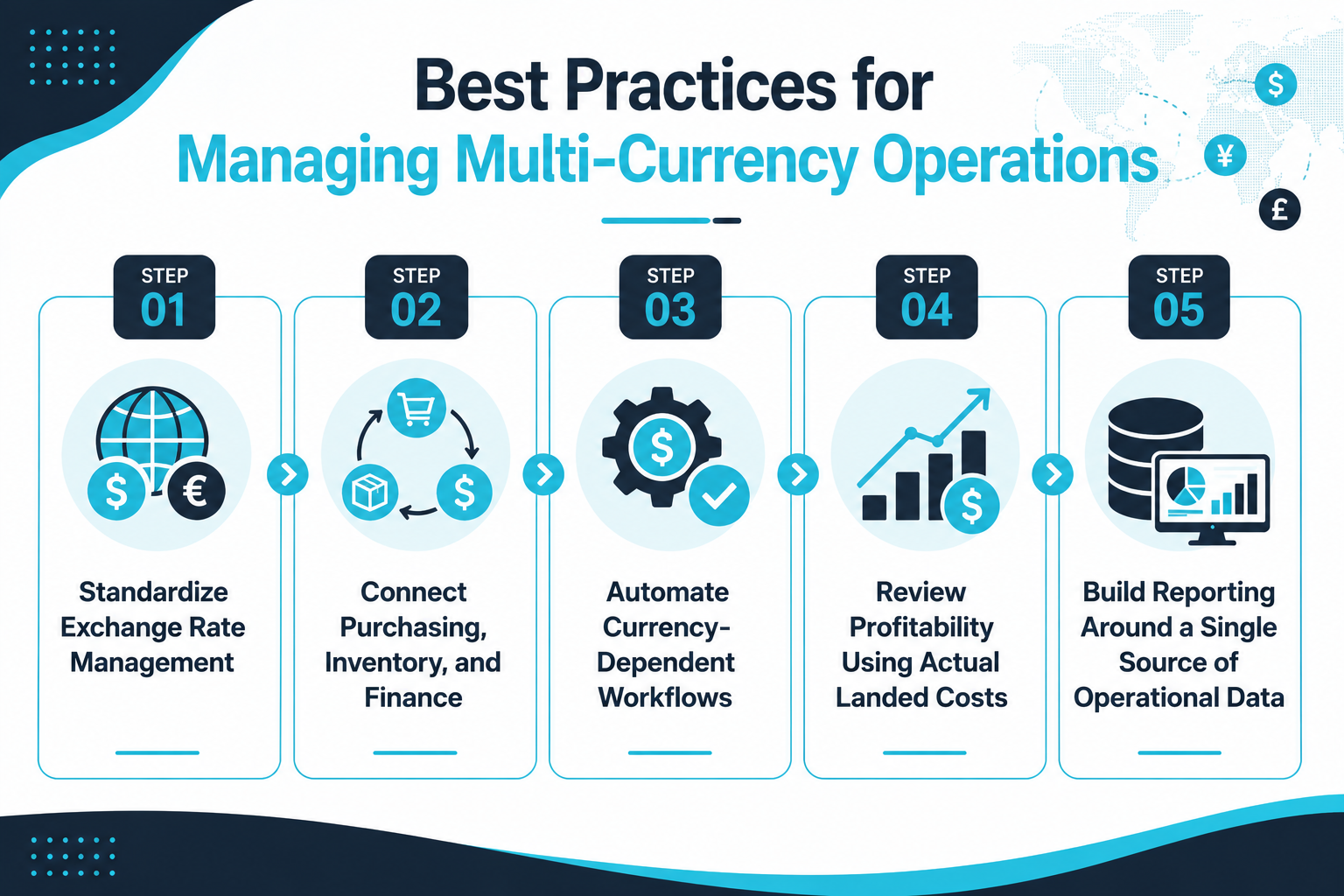
Exchange rate inconsistencies often begin when different departments use different rates for the same transaction. Purchasing may create a purchase order using one exchange rate, while finance records the supplier invoice using another. Inventory costs, landed costs, and financial reports can quickly become inconsistent as a result.
Establishing a clear exchange rate policy helps prevent these discrepancies. Finance teams should define when exchange rates are updated, which rates are used for operational transactions, and how foreign currency revaluations are handled throughout the accounting cycle. Consistency makes reporting more reliable and reduces the amount of reconciliation required at month-end.
International purchases affect far more than accounts payable. Every supplier invoice influences inventory valuation. Freight charges affect landed costs. Warehouse receipts confirm inventory quantities. Finance depends on each of these activities to produce accurate financial reports.
When departments maintain separate records, the same information is entered multiple times and verified repeatedly. Connecting these workflows allows operational updates to flow naturally into financial reporting, reducing duplicate work and improving visibility across the business.
Read More: Why Inventory Visibility Breaks and How Leading Teams Are Fixing It
Manual currency conversions may be manageable for a handful of international transactions, but they become increasingly difficult as supplier relationships and shipment volumes grow.
Automating routine processes such as purchase orders, supplier invoices, landed cost calculations, and exchange rate updates helps reduce manual data entry while improving consistency across operational and financial workflows. Automation also gives finance teams more time to analyze business performance instead of validating spreadsheets and correcting reporting discrepancies.
Gross margin analysis is only meaningful when it reflects the complete cost of bringing products into inventory. Supplier pricing, freight, customs duties, insurance, brokerage fees, and exchange rate fluctuations all contribute to landed cost. Reviewing profitability without accounting for these costs can lead to pricing decisions that gradually reduce margins.
Regularly comparing estimated costs with actual landed costs gives finance and purchasing teams a more accurate understanding of product profitability and supplier performance.
Financial reporting becomes significantly more efficient when purchasing, inventory, logistics, and accounting all reference the same operational data. Instead of reconciling spreadsheets from multiple departments, finance teams can focus on reviewing financial performance, monitoring currency exposure, and supporting better business decisions.
Many importers and exporters continue using QuickBooks as their accounting system while extending it with operational workflows for purchasing, inventory, logistics, and warehouse management. Connecting these functions improves visibility across the business and helps finance teams produce more accurate reports with less manual reconciliation.
Read Next: 9 Signs When To Move Beyond QuickBooks for Global Trade
Managing multi-currency accounting becomes much easier when purchasing, inventory, logistics, and finance share the same operational data. Instead of relying on spreadsheets or manually reconciling transactions across multiple systems, businesses can standardize workflows and reduce duplicate data entry throughout the import and export process.
For many growing businesses, QuickBooks continues to serve as the financial system of record while integrated operational software manages purchasing, inventory, landed costs, warehouse operations, and shipment workflows. Keeping these functions connected improves reporting accuracy, strengthens inventory visibility, and gives finance teams more confidence in the numbers they use to support business decisions.
NEX's Import & Export Software extends QuickBooks by connecting these operational workflows in a single platform. Purchasing, inventory, logistics, landed costs, and accounting remain synchronized, helping businesses simplify multi-currency operations as they grow internationally.
Managing multi-currency accounting becomes more challenging as international operations grow. Exchange rate fluctuations, landed costs, supplier invoices, and inventory movements all affect financial reporting. Keeping these processes connected helps finance teams produce more accurate reports while reducing manual reconciliation.
Key Takeaways
Standardize exchange rate management across the business.
Keep purchasing, inventory, logistics, and finance working from the same operational data.
Reduce manual currency conversions and duplicate data entry.
Base profitability on actual landed costs, not estimates.
Extend QuickBooks with operational workflows as international operations become more complex.
Many importers and exporters continue using QuickBooks for accounting while extending it with operational software that connects purchasing, inventory, logistics, and finance. NEX's Import & Export Software helps businesses simplify multi-currency operations, improve financial visibility, and support international growth without replacing their existing accounting system.
A multi-currency account allows businesses to hold, send, and receive funds in different currencies, while multi-currency accounting focuses on recording and reporting those transactions accurately. Importers and exporters often need both. A currency account helps manage payments across borders, while an accounting system ensures foreign currency transactions, exchange rates, and financial records remain accurate.
QuickBooks supports multi-currency accounting by allowing businesses to record transactions in different currencies and maintain a base currency for financial reporting. However, many importers and exporters also need operational workflows that connect purchasing, inventory, landed costs, and logistics. Extending QuickBooks with integrated accounting software can help streamline accounting processes and reduce manual work without replacing the existing accounting system.
Foreign currency revaluation is the process of updating the value of foreign currency balances using current exchange rates before preparing financial statements. It helps businesses recognize unrealized foreign exchange gains or losses caused by currency volatility. Regular revaluation supports more accurate international accounting and helps maintain compliance with applicable accounting standards.
Reducing currency risk starts with consistent exchange rate management and standardized accounting processes. Businesses should establish policies for using current exchange rates, monitor currency volatility, review conversion costs, and ensure purchasing, inventory, and finance teams work from the same operational data. Many organizations also use multi-currency accounting software to automate currency conversions, improve financial management, and reduce manual accounting tasks.
Businesses often outgrow basic accounting workflows as transaction volumes increase, more customers and suppliers operate in different currencies, or reporting becomes more complex across multiple entities or locations. If finance teams spend significant time managing spreadsheets, reconciling foreign currency accounts, or preparing consolidated financial statements, it may be time to evaluate multi-currency accounting software with multi-currency accounting capabilities that support international business and streamline financial operations.

Identify import and export process inefficiencies, avoid costly delays, and improve global trade workflows with better operational processes.

Discover how disconnected systems create hidden costs for importers and exporters, and how connected workflows improve visibility and productivity.

QuickBooks Online has limitations for import export businesses. Learn how landed costs, documentation, and inventory visibility create workflow gaps.