
1 min read
Trade Compliance Audit Readiness: Best Practices for Importers and Exporters
A trade compliance audit is not just a review of customs paperwork. It is an evaluation of whether your business can consistently demonstrate...

Discover how NEX significantly enhanced First Atlantic Commerce's
operations, billing processes, and overall data management efficiency.
13 min read
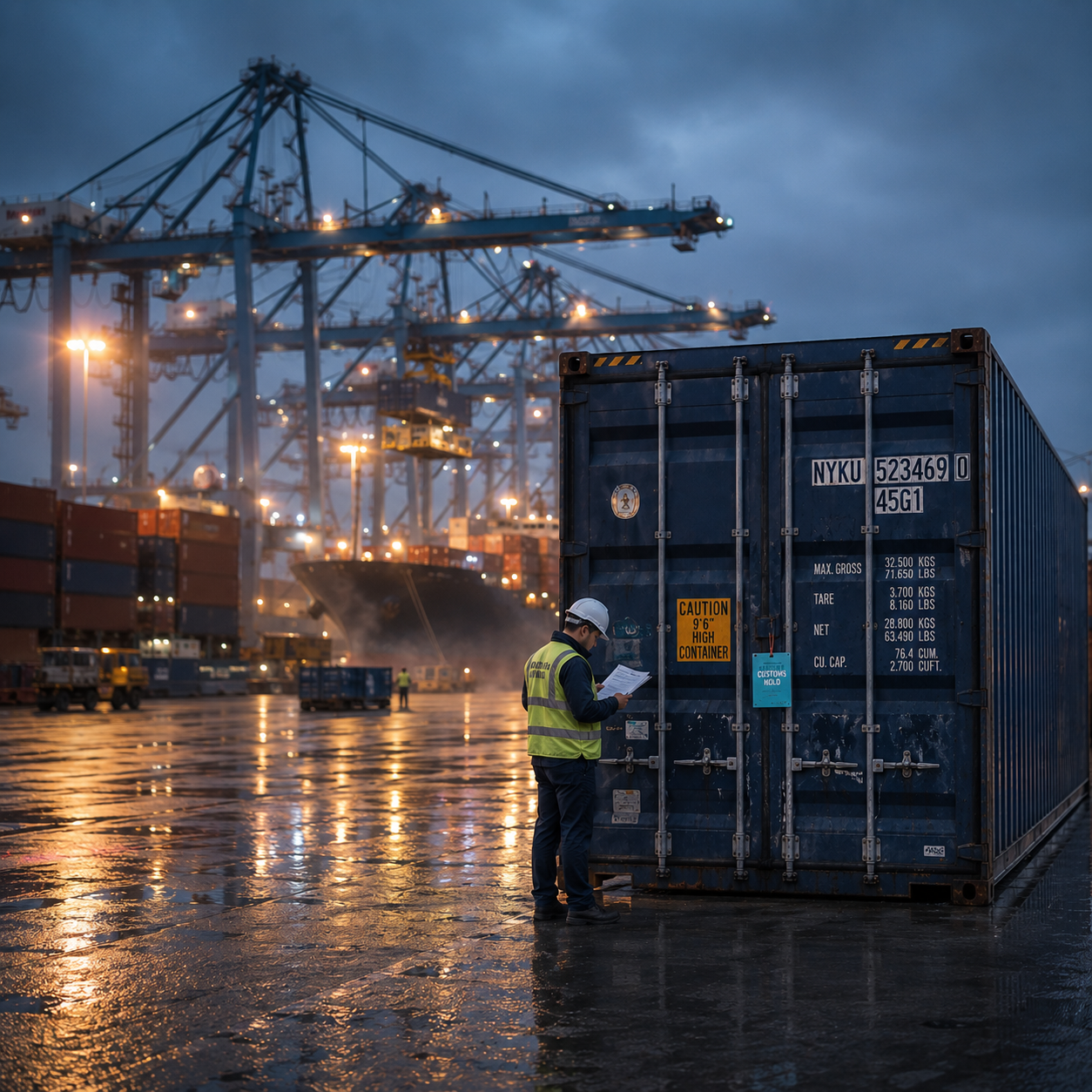
Your shipment is stuck in customs because of incorrect or incomplete data. In the vast majority of cases, customs holds trace back to wrong HS codes, inconsistent declared values, missing details on commercial invoices, or mismatches between what you declared and what's actually in the box.
Customs authorities review shipment paperwork against tariff databases, declared values, product descriptions, country of origin, duties, taxes, and the physical contents of the shipment when needed. If any detail looks incomplete, inconsistent, or unsupported, they can hold the shipment until the importer, exporter, customs broker, or carrier provides clarification.
For businesses managing international shipments, recurring customs delays often point to problems inside the documentation process. Manual data entry, disconnected spreadsheets, outdated commercial invoices, unclear product descriptions, or mismatched packing lists can all create avoidable delays. The goal is to identify exactly why the package is stuck in customs, correct the issue quickly, and prevent the same documentation errors from happening again.
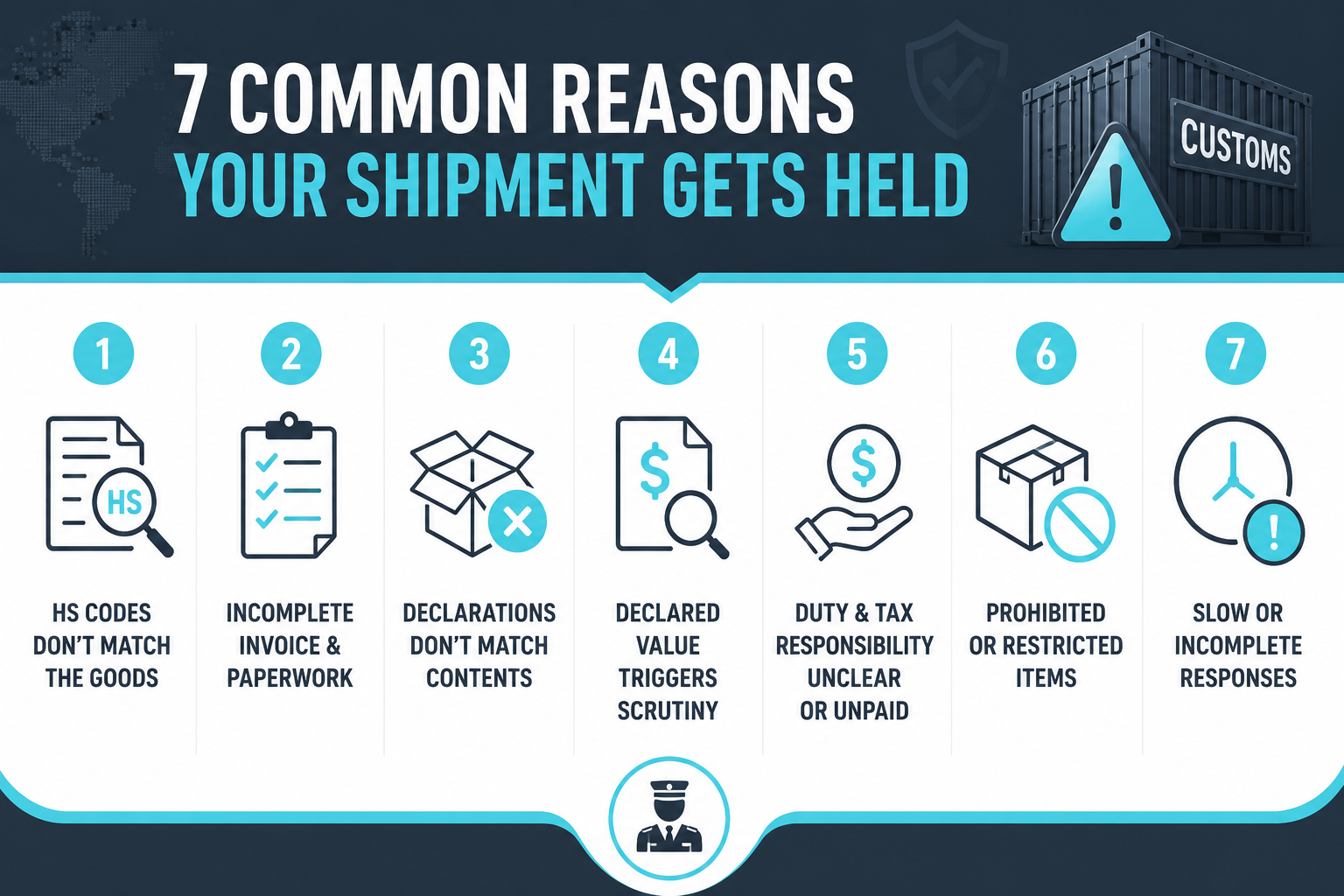
Wrong HS code: HS codes that don't match the contents of the package lead customs to hold shipments.
Incomplete commercial invoice: Missing product descriptions, values, or country of origin causes customs to request further information.
Mismatched customs declaration: When the customs declaration doesn't match what's in the box, shipments are held.
Suspicious declared values: Under-declared or inconsistent values trigger customs scrutiny and delay customs clearance.
Unpaid duty and tax: Shipments are held at customs until customs fees are settled or responsibility is clarified.
Restricted items: Prohibited or restricted items without proper permits will be held by customs or returned.
Slow responses: Delayed or incomplete replies to customs requests keep your package stuck in customs longer.
Customs authorities and customs and border protection teams compare three core documents when your international shipment arrives: the customs declaration, the commercial invoice, and the carrier's manifest data.
They look at the HS code to classify the type of goods, the declared value of the shipment, the country of origin, and whether duty and tax are clearly accounted for. If the paperwork is in order and matches the contents of the package, most shipments are cleared through customs within a day or two. If something doesn't add up (mismatched quantities, vague product descriptions, or inconsistent values), customs officers will flag the shipment for manual inspection or hold it until the discrepancy is resolved.
Some time in customs is normal for every international shipment. Customs processing times vary by route and volume, but tracking usually updates every day or two as the shipment moves through the customs clearing process. Typical time in customs ranges from one to three business days for most US customs and UK customs routes, longer during peak seasons.
Signs the package is stuck in customs include the same "held at customs" or "pending customs" status showing for four or more days with no updates. If tracking hasn't moved in several days, contact your carrier, postal service, or customs broker to see what's happening with the shipment. Customs may inspect certain shipments randomly; that alone doesn't mean something is wrong, but it can add a day or two to customs clearance.
A shipment can get stuck in customs for several reasons, but most customs holds come down to one issue: customs authorities cannot verify the shipment quickly from the information provided. The problem may be an incorrect HS code, incomplete customs paperwork, unclear duty and tax responsibility, restricted goods, or a mismatch between the customs declaration and the contents of the package.
When customs officers find missing, inconsistent, or suspicious details, they may place the shipment on hold until the importer, exporter, carrier, postal service, or customs broker provides the information needed for customs release. Understanding the most common reasons shipments are held helps import and export teams fix the issue faster and avoid unnecessary delays on future international shipping orders.
The HS code is the classification number that tells customs what type of goods you are shipping and what duty rate applies. Customs authorities use the HS code to check the shipment against tariff rules, the commercial invoice, the customs declaration, and the contents of the package.
A shipment may get stuck in customs when the HS code is too generic, outdated, or does not match the actual product. For example, a shipment described only as “electronic parts” may not give customs officers enough information to confirm the correct classification. If the product description, value of the goods, and HS code do not align, customs may hold the shipment for manual review.
Incorrect HS codes can also raise concerns about underpaid customs duties. If customs believes the goods were classified incorrectly, the package may be inspected by customs, reclassified, and assessed for additional duty and tax.
To reduce HS code-related customs delays, maintain a central list of approved HS codes by SKU, review classifications regularly, and work with a customs broker for complex products such as electronics, textiles, chemicals, or regulated goods. Product descriptions, declared values, and HS codes should also match across the commercial invoice, customs form, and customs declaration.
Read Next: HS Code Classification Mistakes: The Hidden Compliance Risk Slowing Down Importers
The commercial invoice is one of the most important documents in the customs process because it helps customs authorities verify the type of goods, value of the shipment, country of origin, HS code, and duty and tax details. If the paperwork is incomplete, the shipment is held at customs until the missing information is corrected.
Mistakes on customs forms, including a CN22 customs form for postal shipments, can cause significant delays to your shipment. Even a small error, such as a missing value, vague product description, or incomplete address, can create customs issues.
To avoid incomplete paperwork holds, use a standardized commercial invoice template, include all required fields, and review the customs paperwork before the shipment is sent. Automating document population from order, product, and customer data can also reduce manual entry errors.
Read Next: Still Using Spreadsheets For Import Export? The Hidden Cost Is Higher Than You Think
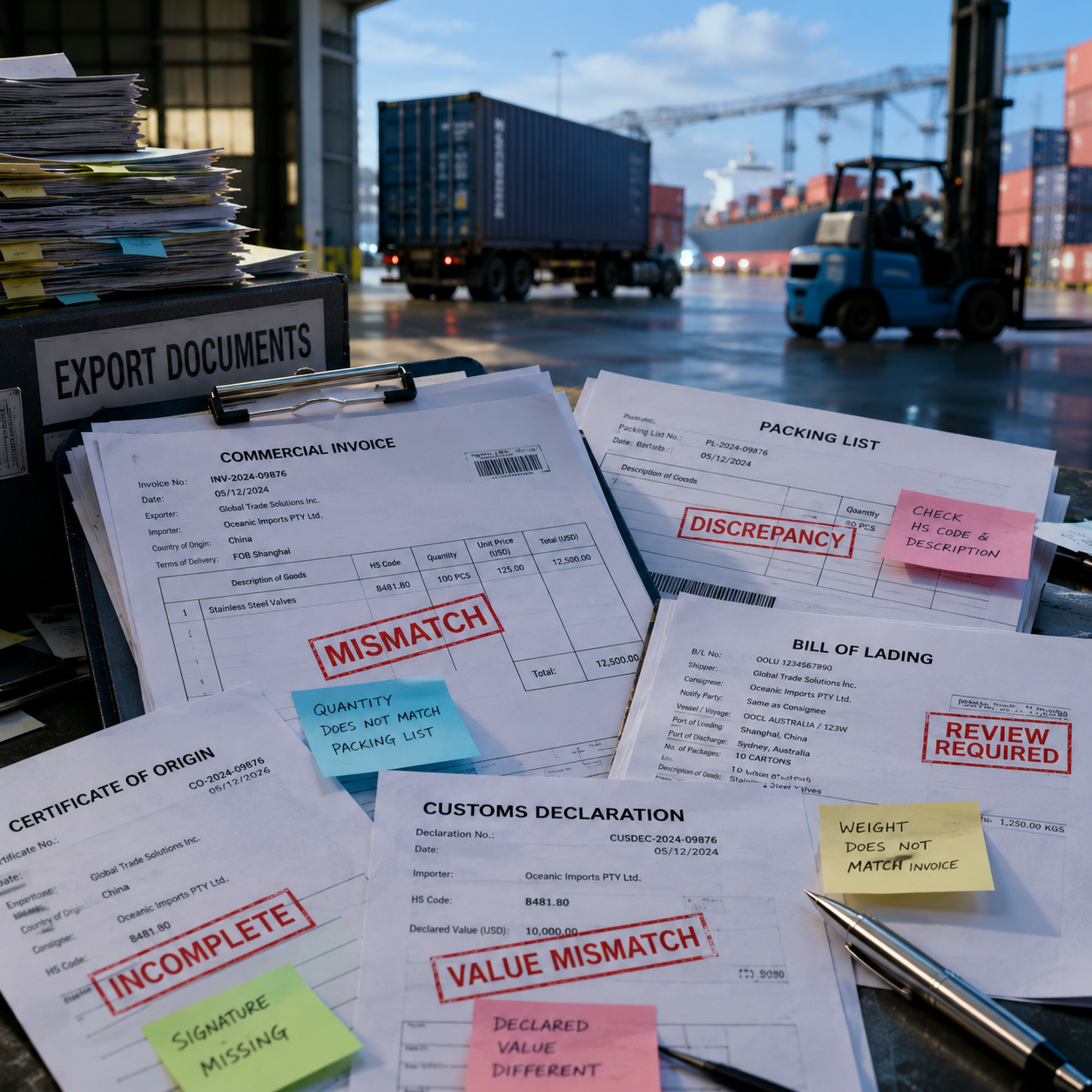
Customs officers do not only review your customs declaration. They may compare it with the physical contents of the package, especially when something looks inconsistent or high-risk. If quantities, weights, item descriptions, or declared values do not match what is actually in the parcel, the shipment can get stuck in customs until the discrepancy is resolved.
This often happens after last-minute order changes, partial shipments, substituted items, or warehouse picking errors. For example, the commercial invoice may still show the original order, while the package contains fewer items because one SKU was out of stock. If the packing list, customs form, and actual contents do not match, customs may hold the shipment or inspect the package.
Mismatched customs declarations are a common reason an international package gets stuck at customs because they suggest either careless documentation or possible misrepresentation. To avoid this, reconcile pick-and-pack data with customs paperwork before the documents are finalized. If an order changes, regenerate the commercial invoice, packing list, and customs declaration before the shipment leaves.
Customs authorities compare the declared value of the shipment with the type of goods being imported and, in some cases, with typical market values or historical shipment patterns. If the value looks unusually low, inconsistent, or unsupported, customs may hold the shipment for review.
This is especially common when samples, warranty replacements, discounts, or promotional items are not explained clearly on the commercial invoice.
To avoid valuation holds:
Use consistent, market-accurate values: Base declared values on actual transaction prices, not arbitrary discounts.
Document discounts and promotions: Add a clear note on the commercial invoice explaining why the value is lower than usual.
Separate samples and warranty items: Use clear descriptions so customs understands the shipment is not a standard sale.
Review historical shipment data: Check whether values for similar goods have changed without a documented reason.
Calculate landed costs before shipping: Understanding duty, tax, freight, and related costs helps prevent surprises.
If customs suspects under-valuation, the shipment may face a customs hold, reassessed customs duties, fines, or delayed customs release.
Read Next: The Hidden Landed Cost Mistakes Quietly Draining Your Import Export Margins
Every international shipment may involve duty and tax obligations. Customs needs to know whether the shipper, recipient, importer, or another party is responsible for payment. If that responsibility is unclear or if customs fees are not paid on time, the shipment may be held at customs until the payment issue is resolved.
Incoterms such as DDP, DAP, and FOB help define who pays, but those terms need to be clear on the commercial invoice and understood by the buyer and seller.
To avoid duty and tax holds:
Clarify Incoterms on every commercial invoice: Make it clear whether the shipper or recipient is responsible for customs duties and taxes.
Communicate costs to the recipient early: If the buyer must pay customs duties, tell them before the package arrives.
Use a customs broker or freight forwarder: A broker can help pre-clear shipments and manage duty and tax payments.
Track landed costs before shipping: Landed cost visibility helps teams understand the total delivered cost before the shipment is sent.
Some goods are prohibited or restricted in specific countries. A product that is legal to sell in one market may require permits, certifications, special labeling, or import approval in another. Common examples include certain chemicals, lithium batteries, pharmaceuticals, food products, tobacco, alcohol, sanctioned goods, and regulated medical or electronic products.
When customs identifies prohibited or restricted items without the required paperwork, the shipment may be held by customs while they request proof of compliance. In some cases, the shipment may be returned, seized, or destroyed, and the shipper may still be responsible for freight, storage, or handling fees.
To avoid this type of customs delay, check the destination country's rules before shipping. Review the product category, required permits, labeling rules, safety documents, and import restrictions for each target market. For complex or regulated goods, work with a customs broker or freight forwarder that understands the product category and local customs requirements.
Customs will notify you, the seller, or your customs broker when they need more information concerning your shipment. Typical customs requests include proof of value, copies of the commercial invoice, product specifications, certifications, or clarification on the HS code. If you don't respond quickly (or if your answer is incomplete), customs will keep the package stuck in customs until they're satisfied.
Slow responses are often a process problem, not a knowledge problem. The customs request goes to an email inbox that isn't monitored daily, or the person who receives it doesn't have access to the documents customs needs, or the documents are scattered across spreadsheets and file shares.
How to avoid response-delay holds:
Designate a customs point of contact: One person or team should monitor for customs requests and have the authority to respond.
Centralize your document library: Store commercial invoices, packing lists, certifications, and product specs in one accessible system.
Set internal response-time targets: Aim to reply to customs requests within 24 hours; faster is better.
Build a standard customs response checklist: Know what documents customs typically asks for and have them ready before the request comes in.
Use a customs broker for complex shipments: Brokers monitor customs communications on your behalf and can respond faster than most internal teams.
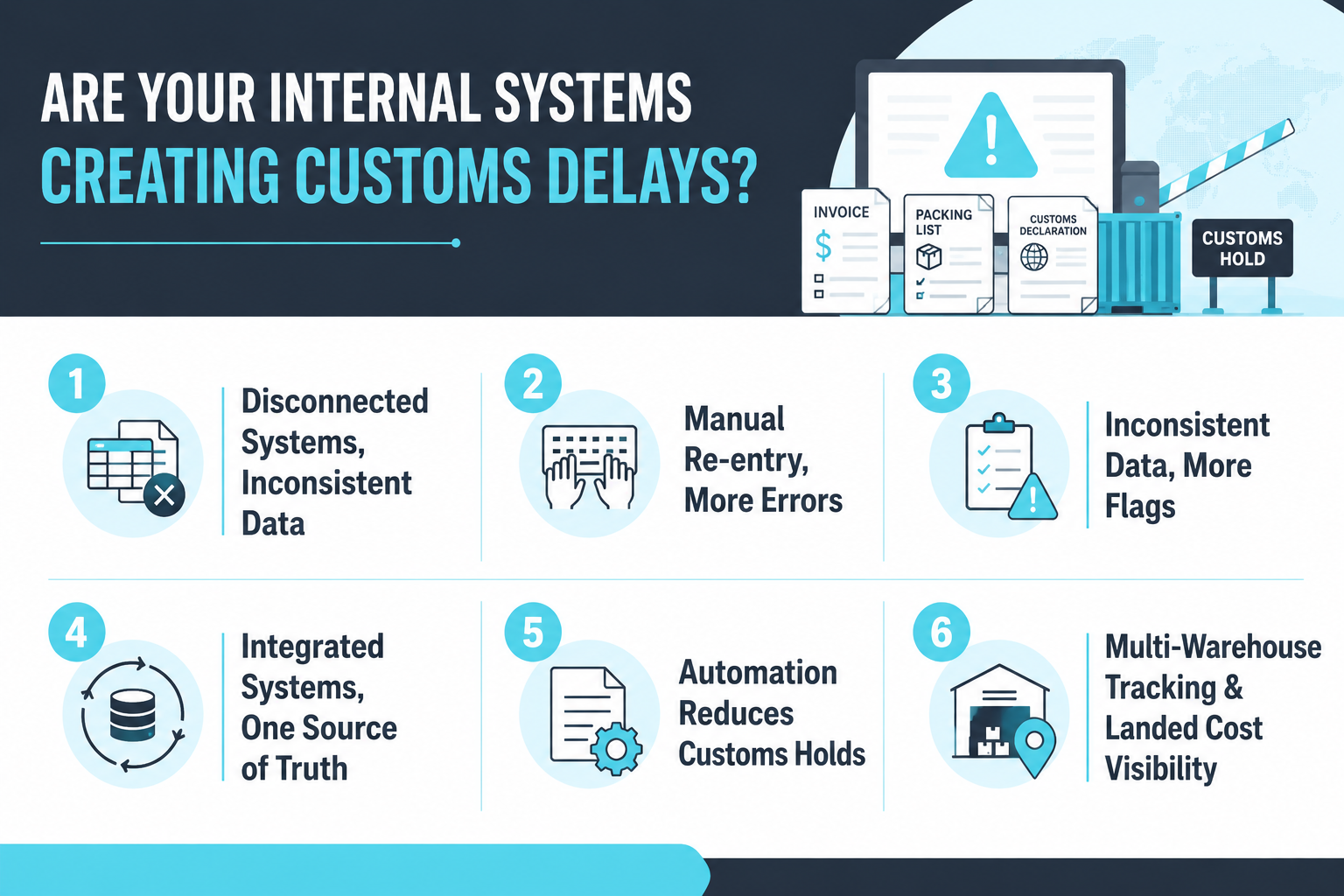
Many customs delays don't start at the border; they start in your office when disconnected systems and manual processes create the inconsistent data that customs officers flag and hold. Here's how internal system gaps turn into customs problems:
QuickBooks handles accounting, but customs forms live in spreadsheets: When item data, shipment details, and customs declarations aren't generated from the same system, values drift and forms conflict, leading to holds when customs compares your commercial invoice to your packing list.
Manual re-entry multiplies error risk: One person updates the order in QuickBooks, another updates the packing list in Excel, and a third types the commercial invoice from memory, creating mismatches in HS codes, quantities, and declared values that customs officers immediately spot.
Every shipment tells a slightly different story: Without a single source of truth, your HS codes, product descriptions, and values vary from shipment to shipment, making customs more likely to flag your packages for manual review.
Integrated systems eliminate data drift: When order management, inventory, and customs documentation pull from the same platform, the HS code, product description, quantity, and value on your commercial invoice match your warehouse records and QuickBooks invoice because they're all generated from one source.
Automation reduces customs holds: Systems that auto-generate commercial invoices, packing lists, bills of lading, and customs declarations from consistent order and product data eliminate the re-keying errors that cause most avoidable customs delays.
Multi-warehouse tracking and landed cost visibility matter: When your system knows what was shipped from where, at what true cost, and what duty and tax apply, you can declare accurate values, respond quickly to customs requests, and avoid the valuation red flags that trigger inspections.
Read Next: The Real Cost of Manual Order Processing (and How to Eliminate It)
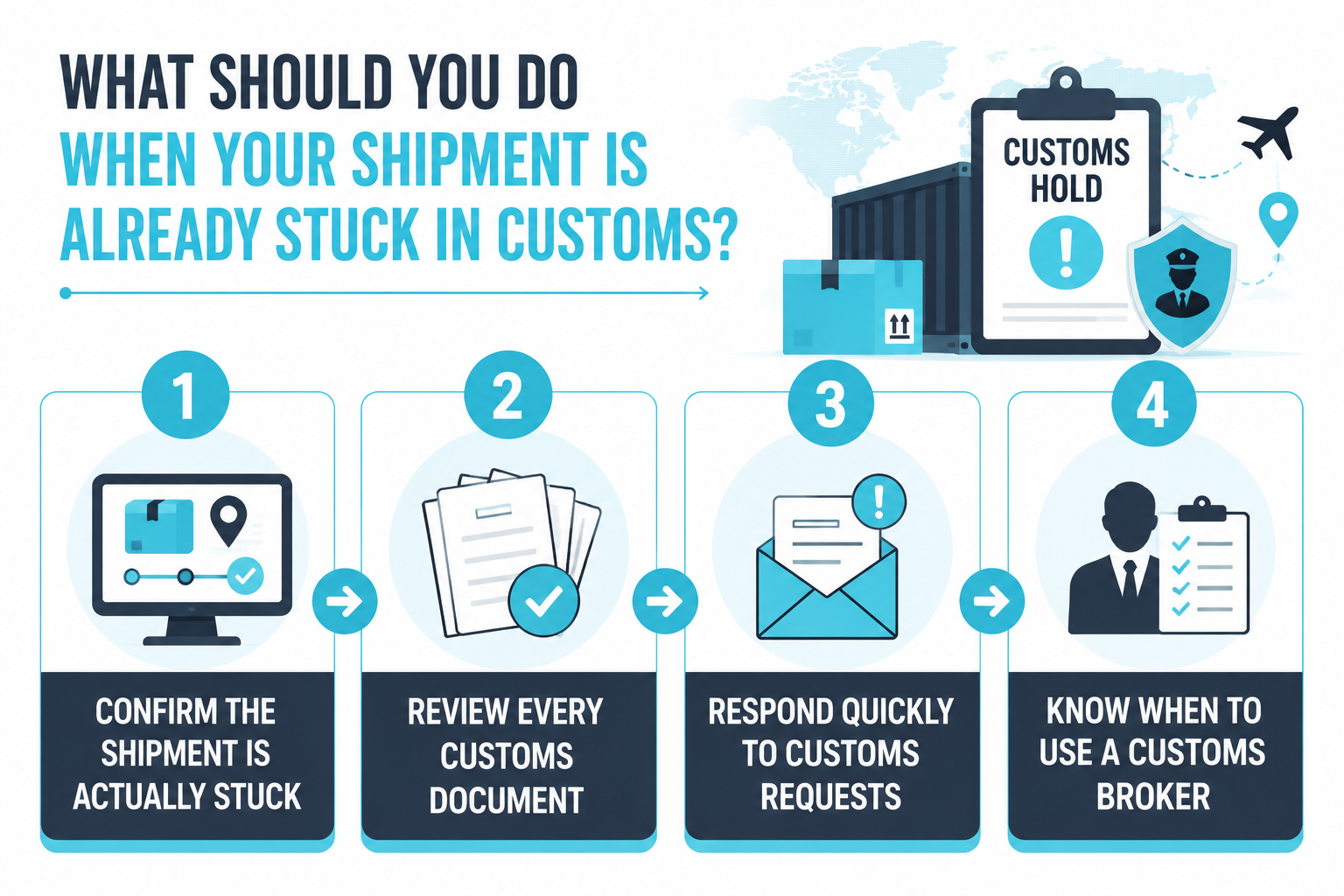
When package tracking says your shipment is stuck in customs or held by customs, first confirm whether it is truly on hold or just moving through normal customs processing. One or two days of “pending customs” can be normal, but four or more days with no update may point to a customs hold.
Start by checking the carrier portal, postal service tracking, or any notes from the customs office. If similar shipments on the same route usually clear faster, contact your carrier or customs broker to ask whether customs has requested more information.
Before escalating, check how long the same customs status has appeared in package tracking. Statuses like “pending customs,” “held by customs,” or “customs clearance in progress” do not always mean there is a serious problem.
Compare the shipment to past international shipments on the same route. If the delay is unusual, contact the carrier, postal service, or customs broker to confirm whether the shipment is actually stuck in customs or waiting for routine clearance.
Pull the documents customs may be checking, including the commercial invoice, packing list, customs form, and any CN22 or CN23 form for postal shipments.
Double-check that these details match across every document:
Description of goods
Quantities and weights
HS code
Value of the shipment
Country of origin
Shipper and consignee addresses
Look for common errors such as transposed digits, vague product descriptions, missing country of origin, incorrect HS codes, or values that do not match. If you find a mistake, send corrected documents through your carrier or customs broker instead of waiting for customs to ask again.
Customs requests may come through your customs broker, carrier portal, postal service, or local customs office. Check these channels daily while the shipment is in transit.
When customs asks for more information, send one complete response. Include the requested commercial invoice, product specifications, certificate of origin, proof of value, or corrected customs paperwork. Partial answers can keep the shipment held in customs longer.
If a document is unavailable, explain why and provide a useful alternative, such as a manufacturer’s declaration, product photo, or detailed product specification sheet.
Some customs holds are simple, such as a missing invoice or unpaid duty and tax. Others need a customs broker, especially when the issue involves:
Repeated customs delays for the same product
HS code disputes
High-value shipments
Sensitive or regulated goods
Strict import regulations in the destination country
A customs broker can help interpret the customs issue, communicate with customs officers, and submit the right documents in the right format. The broker handles the customs relationship, while your internal system should make sure shipment data, commercial invoices, packing lists, and product details are accurate and easy to access.
Read Next: Tracking Landed Costs & Compliance in QuickBooks: A Guide for Importers & Exporters
While customs is complex, most avoidable customs delays trace back to a short list of fixable problems: inconsistent data, incomplete documentation, and disconnected internal processes. Every international shipment passes through the same basic checks, and shipments are held when the information customs sees doesn't add up.
Standardize HS codes, product descriptions, and values: Customs sees a consistent story every time, reducing the risk of holds and manual inspections.
Automate commercial invoice and customs paperwork from a single data source: Eliminate re-keyed errors and ensure every document matches the contents of the package.
Use integrated order, inventory, and import/export tools: Calculate landed costs and duties before shipping, track multi-warehouse inventory, and respond faster to customs requests.
Once your internal process is stable, the right platform keeps every shipment aligned automatically.
NEX Import Export Software for QuickBooks integrates order management, compliance, logistics, and financial tracking in one platform connected to QuickBooks. Prevent delays by centralizing your import/export workflows, automating customs documents, and keeping every shipment aligned with QuickBooks.
Normal customs processing takes one to three business days for most routes, though peak seasons and random inspections can extend this. If your tracking shows the same "held at customs" status for four or more days without updates, the shipment is likely facing a real hold that requires action.
Even when paperwork looks complete, customs may hold shipments due to random inspections, inconsistencies between your declared HS code and typical classifications for similar goods, or valuation red flags where your declared value differs significantly from market norms or your own historical shipments. Customs also holds shipments when the duty and tax responsibility isn't clear or when restricted items require additional permits you haven't provided.
The most common mistakes include incomplete commercial invoices (missing product descriptions, quantities, HS codes, or country of origin), mismatched data between the customs declaration and the physical contents of the package, incorrect or generic HS codes that don't match the actual goods, and under-declared or inconsistent values that trigger customs scrutiny. Even small errors like transposed digits or vague descriptions can cause holds.
Customs authorities compare your declared HS code against their database to determine the correct duty rate and verify the type of goods. When the code is wrong or generic, customs officers stop the shipment to manually verify contents, which can take days. Incorrect values (especially under-declared values) raise red flags that you're trying to minimize customs duties, triggering manual review, re-assessment, and potential penalties.
Hire a customs broker when you face repeated customs issues with the same product, complex HS code disputes, high-value or sensitive shipments, or when shipping to countries with strict import regulations. Brokers can interpret customs issues, negotiate with customs officers, and provide the right documentation in the right format to help clear customs faster than most internal teams can manage alone.
Check how long your tracking has shown the same customs status: one to two days of "pending customs" is normal processing; four or more days without updates suggests a real hold. Compare your current shipment to past shipments on the same route to understand typical processing times, and cross-verify with your carrier or postal service for any internal notes from the customs office.
Integrated import/export systems that connect order management, inventory, and customs documentation in one platform ensure consistent data across all documents. These systems automatically generate commercial invoices, packing lists, and customs declarations from the same source, calculate landed costs and duties before shipping, and centralize product data (including HS codes and values) to reduce the inconsistencies that cause customs holds.
QuickBooks handles accounting and basic inventory, but specialized import/export software extends it by automating customs document generation from consistent order and product data, managing multi-warehouse tracking, calculating landed costs, and ensuring that HS codes, values, and product descriptions stay aligned across every commercial invoice and customs declaration. This integration eliminates manual re-entry and the data drift that causes customs to hold shipments.

1 min read
A trade compliance audit is not just a review of customs paperwork. It is an evaluation of whether your business can consistently demonstrate...
1 min read
Import and export businesses make many recurring documentation mistakes that trigger customs delays, fines, and shipment holds: invoice and packing...

1 min read
QuickBooks Online is one of the most widely used accounting systems for small and mid-sized businesses. It handles bookkeeping, invoicing, financial...