

13 min read

The biggest hardware supply chain challenges for electronics and IT hardware distributors include unpredictable supplier lead times, volatile SKU demand, limited stock visibility, backorders, multi-location inventory, and complex returns. These problems make it harder to know what you can promise customers, when to reorder inventory, and where to allocate available stock.
Recent industry data shows that supply constraints remain a concern. According to the Global Electronics Association’s August 2026 Global Sentiment Survey, 64% of electronics manufacturers reported limited component and material availability or extended lead times, while 53% said supplier lead times had increased from the previous quarter.
For distributors, upstream changes can quickly affect purchasing, stock availability, backorders, and fulfillment. Better visibility across orders, inventory, procurement, warehouses, and returns helps teams respond before those issues spread across the operation.
Why IT Hardware Supply Chains Are Especially Difficult to Manage
IT hardware distributors operate in a category where product demand, supplier availability, and inventory value can change quickly. Teams must manage broad SKU catalogs, short product lifecycles, uncertain lead times, and high expectations for fast fulfillment, often across multiple warehouses, suppliers, and customer accounts.
Those conditions create a narrower margin for error. A purchasing decision made too early can leave the business holding aging inventory, while a delayed order can lead to stockouts, backorders, and missed customer commitments. The challenge grows when sales, purchasing, warehouse, and service teams work from different systems or versions of inventory data.
These factors tend to reinforce one another. A supplier delay can create a backorder, which may force inventory to be reallocated across customers or locations. A sudden demand shift can expose gaps in purchasing forecasts. A return or warranty replacement can further reduce the stock available for new orders.
For electronics and IT hardware distributors, effective supply chain management depends on maintaining accurate, current information across the full flow of inventory. The sections below examine the specific supply chain challenges that most often make that difficult.
Read Next: Top Supply Chain Issues and How to Overcome Them in 2025
10 Major Supply Chain Challenges for Electronics and IT Hardware Distributors
Hardware distributors often face supplier uncertainty, short product lifecycles, shifting demand, distributed inventory, and complex fulfillment requirements at the same time. For electronics and IT hardware distributors, these issues often overlap, which makes them harder to manage in isolation.
The following challenges have the greatest day-to-day impact on purchasing, inventory control, fulfillment, customer service, and working capital.
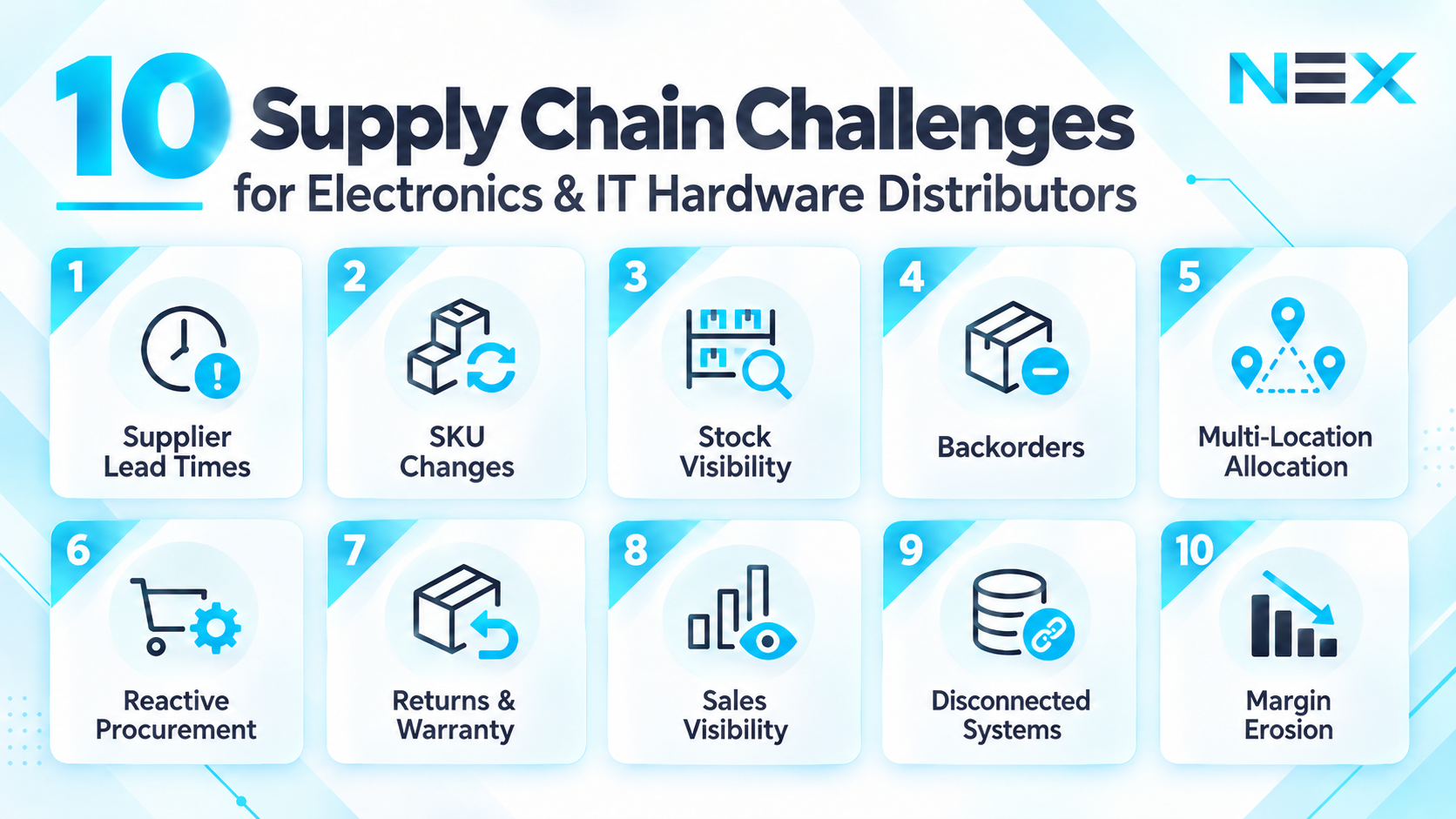
1. Supplier Lead Times Are Difficult to Predict
Supplier lead times can change after a purchase order has already been placed. Component shortages, production constraints, freight delays, manufacturer allocation policies, and upstream disruptions can all move expected receipt dates.
For a distributor, that change can affect far more than procurement. Consider a customer order that depends on 50 units arriving from a supplier next week. If the expected delivery moves out by three weeks, the team may need to decide whether to source elsewhere, split the order, transfer stock from another warehouse, or revise the customer's delivery date. Those decisions are harder when supplier updates, purchase orders, customer demand, and inventory allocations are tracked separately. Useful visibility should include:
-
Open purchase orders and expected receipt dates
-
Current supplier lead times
-
Inventory already committed to customer orders
-
Backordered quantities
-
Incoming inventory and planned allocation
-
Alternative suppliers or locations when available
Better data cannot prevent a supply chain delay, but it can give the team more time to respond before the delay affects fulfillment.
2. Rapid SKU Changes Make Inventory Planning Harder
Hardware inventory can lose value quickly when manufacturers release new models, discontinue products, or change specifications. These lifecycle changes are common across many hardware categories and can quickly affect demand for existing inventory.
A traditional forecast based heavily on historical sales may struggle with these changes. Purchasing teams also need current customer orders, product lifecycle information, available stock, and incoming supply when deciding how much to reorder.
3. Stock Visibility Breaks Down Across Systems and Locations
Inventory visibility becomes unreliable when accounting, warehouse, purchasing, and sales teams maintain separate records. One system may show the physical quantity on hand while another reflects open orders or incoming stock. For operational decisions, a single inventory number is rarely enough. Teams typically need to distinguish between:
-
On hand: Physical inventory currently recorded
-
Available: Inventory that can still be committed
-
Allocated: Stock already reserved for existing orders
-
Incoming: Inventory expected from open purchase orders
-
Backordered: Demand that current inventory cannot fulfill
For example, a system may show 40 units on hand. If 35 are already allocated to customer orders, the sales team does not really have 40 units available to promise. Real-time visibility across those inventory states helps sales, purchasing, and warehouse teams work from the same picture of supply.
Read More: Why Inventory Visibility Breaks in Supply Chains
4. Backorders Create Fulfillment and Customer-Service Problems
Backorders are common when supplier availability and customer demand do not line up. Each shortage triggers a series of operational decisions. A typical sequence looks like this:
-
A supplier shipment is delayed or arrives short.
-
Available inventory falls below committed demand.
-
One or more customer orders move into backorder.
-
Operations must decide how limited stock should be allocated.
-
Purchasing evaluates alternative sources or revised replenishment dates.
-
Sales or customer service updates affected customers.
-
Incoming inventory must eventually be matched back to the correct orders.
Without connected order and inventory data, teams may manage those steps through email, spreadsheets, and manual follow-up. That increases the risk of inconsistent customer commitments, duplicate purchasing, or incoming inventory being allocated to the wrong order.
Read More: B2B Order Fulfillment Issues That Hurt Performance
5. Multi-Location Inventory Complicates Allocation
With multi-location inventory, stock may exist somewhere in the business but not where it is needed. Suppose a customer needs 12 units:
-
Warehouse A has 0 available.
-
Warehouse B shows 10 units, but 6 are already allocated.
-
Warehouse C has 15 units arriving next week.
-
Another customer has a larger order scheduled to ship from Warehouse C.
A company-wide inventory total does not answer the fulfillment question. Operations teams need location-level visibility into available stock, allocations, transfers, incoming shipments, and customer demand. They can then decide whether to transfer inventory, split the shipment, wait for incoming stock, or create a new purchase order.
Without that view, distributors may buy products they already have elsewhere or leave usable inventory sitting in the wrong location.
Read More: Multi-Location Inventory Management Best Practices
6. Hardware Procurement Becomes Reactive
Hardware procurement often becomes reactive when buyers cannot connect customer demand with current inventory and incoming supply.
Purchasing teams may compensate by carrying larger buffers, placing emergency orders, or relying heavily on spreadsheets. Those approaches can keep orders moving in the short term, but they may also increase inventory levels and purchasing costs.
A stronger hardware procurement process connects sales orders, available inventory, open purchase orders, supplier lead times, and backorders before a buying decision is made. That helps procurement teams distinguish between a genuine shortage and a temporary visibility problem.
7. Returns, Repairs, and Warranty Activity Add Inventory Complexity
A hardware sale can generate operational work long after the original shipment leaves the warehouse. Returns may involve exchanges, repairs, warranty evaluation, supplier claims, replacement units, credits, or restocking. Each path changes what should happen to the product and how it should appear in inventory. A typical RMA workflow may look like:
Customer return → receipt and inspection → disposition decision → repair, replacement, or restock → inventory update → supplier or warranty action → credit or replacement
The process becomes harder when the RMA is disconnected from the original customer order, serial or product information, warehouse record, and accounting transaction. Teams should be able to identify what was sold, why it came back, where the returned product is now, what action is required, and whether a replacement or financial adjustment is still outstanding.
For distributors handling a meaningful volume of returns, repairs, and warranty claims, NEX’s Return Merchandise Authorization module helps keep those activities connected to the original customer, product, order, and inventory records.
Read More: Simplify Your Returns Management Process to Cut Costs and Delays
8. Sales Teams Lack Reliable Inventory and Order Information
Sales teams often need to answer simple customer questions quickly:
-
Is the product available?
-
How many units can ship?
-
When will the rest arrive?
-
Has the order been allocated?
-
Which warehouse will fulfill it?
-
When is the expected ship date?
Those questions become difficult when sales, warehouse, and purchasing teams rely on different systems. A salesperson may see stock in an accounting system without knowing that it has already been allocated. Another may need to contact the warehouse manually before confirming availability. Customer service may have to ask purchasing for an updated lead time before responding to a backorder inquiry.
These delays create extra internal work and make customer commitments less reliable. Shared inventory, purchasing, and order data gives customer-facing teams a better basis for answering those questions.
9. Disconnected Systems Slow Supply Chain Decisions
Growing distributors often add software as new needs arise. Over time, the operating environment may include:
-
QuickBooks for accounting
-
Spreadsheets for purchasing or forecasting
-
CRM software for customer activity
-
A separate warehouse or shipping application
-
Supplier updates stored in email
-
Standalone tools for service or returns
-
Manual reports used to reconcile the systems
Each application may work for its specific purpose, but the handoffs between them create friction. A sales order may need to be re-entered elsewhere. Purchasing may rely on an exported spreadsheet. Warehouse updates may reach sales only after someone checks another system. Returned hardware may be tracked outside the original order.
The result is often duplicate entry, inconsistent records, delayed reporting, and more time spent confirming which information is current. For supply chain leaders, the practical concern is decision speed. When teams must assemble information from several systems before acting, even routine inventory or fulfillment decisions can take longer than necessary.
10. Supply Chain Disruptions Can Quietly Erode Order Margins
A hardware order can look profitable when quoted and end with a much smaller margin by the time it is fulfilled. Supplier price changes, expedited freight, split shipments, alternate sourcing, duties, and returns can all increase fulfillment costs after the original selling price has been set.
Consider a distributor that quotes 100 units based on its normal supplier cost and standard freight. If the supplier can only deliver 60 units on time, the remaining 40 may need to come from another source at a higher price. The distributor may also pay expedited shipping to protect the customer’s deadline. The order is fulfilled, but the economics have changed.
The problem becomes harder to manage when purchasing, freight, warehouse, returns, and accounting data sit in different systems. Operations may see the fulfillment issue, while finance sees the added cost later, making it difficult to understand how a sourcing or shipping decision affected the final margin on the order.
Better cost visibility helps supply chain teams evaluate those tradeoffs while there is still time to act. If teams can see how alternate sourcing, expedited freight, split shipments, or returns affect order economics, they can make more informed decisions about how to protect customer commitments without absorbing avoidable costs.
How These Hardware Supply Chain Challenges Compound
For IT hardware distributors, one supply chain problem can quickly trigger several others. A supplier delay can trigger a shortage, which creates backorders, changes warehouse priorities, increases customer-service workload, and may force the business to source inventory at a higher cost. A common chain of events looks like this:
-
A supplier pushes out a delivery date.
-
Available inventory falls below committed demand.
-
Customer orders move into backorder or partial fulfillment.
-
Operations reallocates stock across customers or locations.
-
Procurement looks for alternate supply or expedited options.
-
Sales updates delivery commitments and customer expectations.
-
Additional freight, sourcing, or handling costs reduce order margin.
Operational Example
Suppose a distributor has 80 network switches committed across three customer orders, with 50 more units due from a supplier next week. The supplier then moves the shipment out by three weeks. One warehouse has 20 units available, another has 15, and the rest of the on-hand stock is already allocated.
Operations now has to decide which orders receive the remaining inventory, whether stock should be transferred between locations, and whether a partial shipment makes sense. Procurement may need to source additional units from a secondary supplier at a higher cost, while sales updates customers on revised delivery dates. If those decisions are made across separate systems or spreadsheets, the risk of conflicting information, duplicate purchasing, and unnecessary freight increases.
The same pattern can begin with a sudden demand spike, a discontinued SKU, an unexpected return, or inaccurate inventory data. Once one part of the operation changes, purchasing, warehouse, sales, service, and finance may all need to respond.
Fragmented systems slow the response because teams must reconcile information across separate spreadsheets, applications, or reports before they can act.
What Better Supply Chain Visibility Looks Like for IT Hardware Distributors
For an IT hardware distributor, supply chain visibility means knowing what can actually be sold, sourced, transferred, and fulfilled at any given moment. That requires more than an inventory balance.
Teams need to understand which units are already committed, what is arriving from suppliers, where stock sits across locations, which customer orders are at risk, and how returns or replacement activity may change available supply. A useful visibility framework should answer practical questions such as:
For distributors that need to manage inventory across these different states and locations, NEX’s Inventory Management module connects inventory availability, allocation, movement, purchasing requirements, and related operational activity.
Connecting these areas gives teams the context needed to make faster, better-informed decisions. If a supplier pushes out a delivery date, teams should be able to see which customer orders are affected, whether inventory exists at another location, and what incoming stock is already committed.
Current operational data also makes exception management easier. Supply chain leaders can focus on delayed purchase orders, low-stock items, backorders, unusual demand, and unresolved returns instead of spending time assembling reports from several systems.
For growing distributors, this shared visibility creates a stronger basis for day-to-day decisions. Sales can make more reliable delivery commitments, procurement can buy against current demand, warehouse teams can prioritize the right orders, and management can see where supply chain issues are beginning to affect customers or margin.
Read Next: Freight Data Visibility Issues: Closing Supply Chain Visibility Gaps
How Electronics Distributors Can Improve Supply Chain Control
Electronics distributors can improve supply chain control by making the flow of information between sales, purchasing, inventory, warehouses, suppliers, and returns more consistent. The most useful improvements usually come from reducing manual handoffs, clarifying inventory status, and giving each team access to the operational data needed to make decisions quickly.
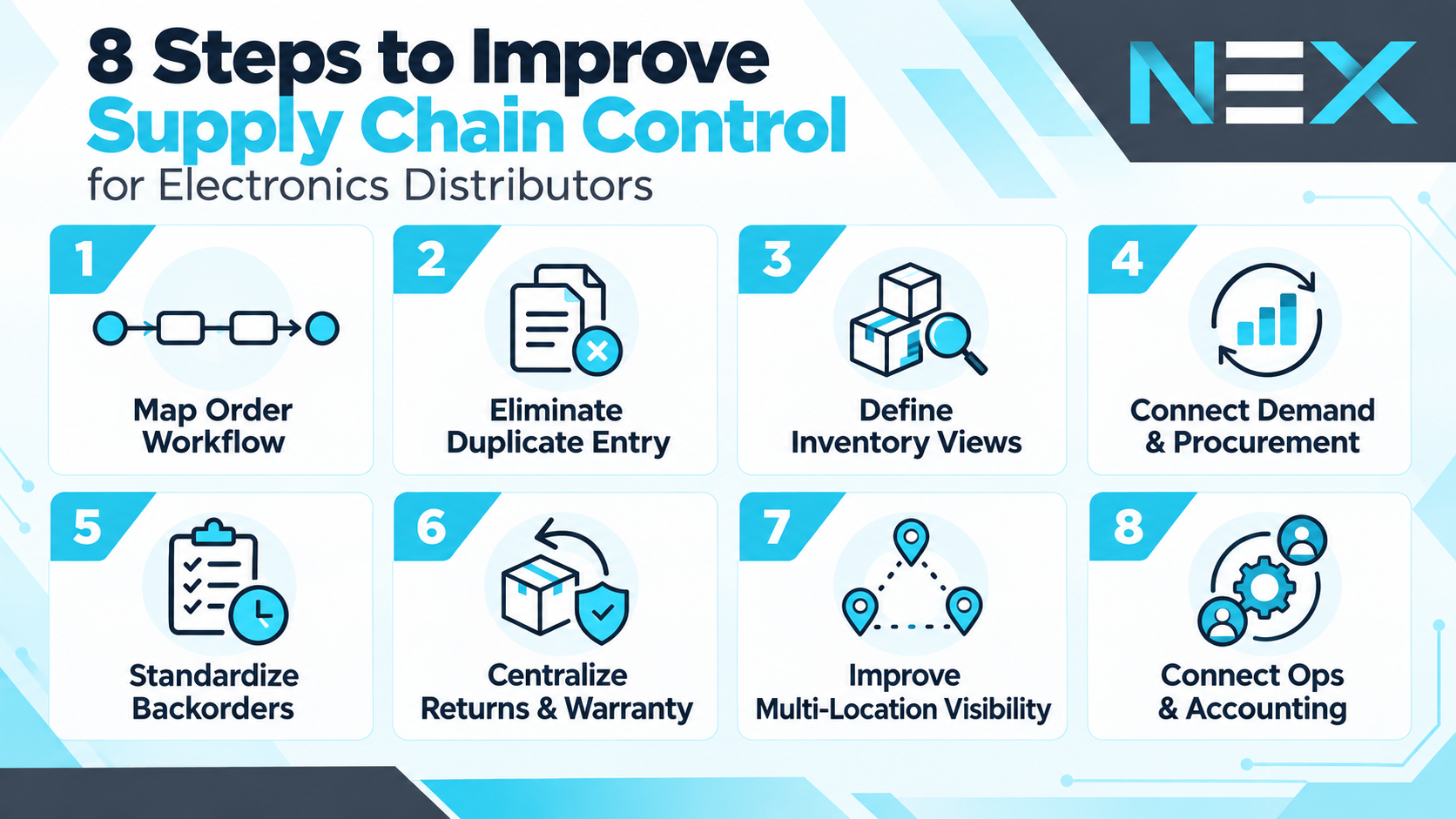
A practical approach is to work through the areas where delays, duplicate entry, and conflicting information are most likely to occur:
-
Map the order-to-fulfillment workflow: Document how an order moves through allocation, purchasing, fulfillment, shipping, invoicing, and returns. Flag handoffs that rely on spreadsheets, email, or manual follow-up.
-
Eliminate duplicate data entry: Identify where customer, SKU, order, supplier, or shipment information is entered more than once. Reducing re-entry helps limit mismatched quantities, dates, and statuses.
-
Define the inventory views each team needs: Make sure teams can distinguish between on-hand, available, allocated, incoming, backordered, and location-specific inventory.
-
Connect demand with procurement: Give buyers visibility into open customer demand, current stock, incoming purchase orders, and likely shortages before new orders are placed.
-
Standardize backorder and allocation rules: Set clear rules for how limited inventory is prioritized across customers, locations, and partial shipments.
-
Centralize returns and warranty workflows: Keep RMAs, repairs, replacements, credits, and supplier actions tied to the original order and inventory record.
-
Improve multi-location visibility: Show what each warehouse has, what is already committed, what is incoming, and whether stock can be transferred before purchasing more. For distributors coordinating this across several facilities, NEX’s Warehouse Management Software connects receiving, inventory locations, stock movement, picking, packing, shipping, and multi-warehouse operations.
-
Connect operational and accounting data: For distributors using QuickBooks, keep accounting as the financial system of record while managing orders, inventory, purchasing, warehouses, shipping, and returns in a more connected operational workflow.
These steps reduce time spent reconciling systems and help teams identify shortages earlier, prioritize backorders, coordinate purchasing, and respond to supplier changes before they disrupt fulfillment.
As SKU counts, locations, order volume, and supplier relationships expand, maintaining that level of control becomes harder. The objective is to make supply chain decisions from current operational data rather than from delayed reports or disconnected spreadsheets.
When Spreadsheets and QuickBooks Alone Are No Longer Enough
QuickBooks can remain a strong accounting system even after an electronics distributor’s operational needs become more complex. The operational gap usually becomes clear when teams rely on spreadsheets, email, and separate tools to manage inventory allocation, purchasing, backorders, warehouse activity, returns, and fulfillment.
Common warning signs include:
- Sales has to confirm product availability manually.
- Purchasing relies on spreadsheets for replenishment.
- Inventory numbers differ across systems or locations.
- Backorders and RMAs are tracked outside the main workflow.
- Teams re-enter the same order or product data.
- Management combines multiple reports to understand current operations.
These signs typically point to gaps in the operational systems surrounding accounting. NEX’s Electronics and Technology Distribution Software connects order management with inventory, purchasing, warehouse operations, shipping, and returns while allowing QuickBooks to remain the accounting system of record.
For growing distributors, that means less manual reconciliation and stronger coordination across the workflows connecting customer orders to accounting.
Stronger Hardware Supply Chains Start With Connected Operations
Supplier delays, inventory shortages, backorders, and warehouse decisions often affect one another. Disconnected data can make the response slower and more expensive. For electronics and IT hardware distributors, stronger supply chain control depends on how well teams can coordinate those decisions across sales, purchasing, warehouse, service, and finance.
Key Takeaways
-
Track available, allocated, incoming, and backordered inventory separately.
-
Connect purchasing decisions to current customer demand and open supply.
-
Standardize how limited stock, transfers, and backorders are prioritized.
-
Keep returns and RMA activity connected to customer and product records.
-
Reduce manual handoffs between operational teams.
Distributors facing these challenges should identify where operational handoffs are breaking down and assess whether their current systems can support continued growth. If you want to explore how NEX could fit your accounting and distribution workflows, get in touch with us to discuss your requirements.
Frequently Asked Questions
What are the best practices for managing hardware supply chain issues?
Best practices include maintaining accurate inventory status, connecting customer demand with purchasing, tracking supplier lead times, and standardizing backorder and allocation rules. Distributors should also identify single points of failure in their supplier network and maintain alternate sourcing options for critical products when possible.
How do semiconductor shortages affect electronics and IT hardware distributors?
Semiconductor shortages can reduce the availability of laptops, networking equipment, computing devices, and other hardware components. Longer lead times and tighter supplier allocations can create backorders, disrupt fulfillment plans, and force distributors to revisit purchasing and customer delivery commitments.
How can distributors improve supply chain agility during shortages?
Supply chain agility improves when teams can see current demand, available stock, incoming supply, and supplier commitments in one place. Distributors can also respond faster by maintaining multiple sourcing options, setting clear allocation rules, and reviewing likely shortages before they affect customer orders.
How can electronics distributors reduce supply chain risk when supplier availability changes?
Distributors can reduce risk by tracking supplier lead times, maintaining accurate inventory data, identifying critical dependencies, and preparing alternate sourcing options where practical. Clear allocation and backorder rules also help teams respond consistently when available supply falls short of customer demand.
How should electronics distributors build a stronger supply chain strategy?
A stronger supply chain strategy should combine supplier diversification, accurate inventory data, demand planning, and contingency processes. Distributors should understand where they depend heavily on individual suppliers, regions, or critical components and prepare practical alternatives before those dependencies become operational bottlenecks.